Most manufacturer websites have the same hidden problem: they look fine to a human visitor, but to Google they're practically blank. That's exactly where Glassics.in was — a family-run architectural glass hardware business with a website that search engines couldn't read.
Key takeaways
- A JavaScript-only website can be invisible to Google even when it looks fine to visitors.
- Glassics.in was rebuilt as 195 pre-rendered pages: 147 product pages, 23 range pages, plus guides and a glossary.
- One page per product means every product can match an exact buyer search.
- SEO, AEO and GEO were built into the foundation — not bolted on afterwards.
- Test your own site: view source and search for a product name. If it isn't in the HTML, Google can't see it either.
We rebuilt it from the ground up. Here's what changed, why it matters, and what any manufacturer can learn from it.
Why couldn't Google see the Glassics website?
The old Glassics.in was built as a JavaScript-only application. That means when a visitor opened the site, their browser ran code to assemble the page on the spot. It looked normal on screen — but when Google's crawler visited, it often saw little more than an empty shell.
For a manufacturer, that's fatal. Your buyers search for specific things: "slim aluminium partition profile 16×45", "glass door patch fitting manufacturer", "shower hinge 135 degree". If those words only exist inside JavaScript that a crawler may or may not execute, you don't rank. You don't exist.
Glassics had the products and the technical detail. What it didn't have was a website that let any of that be found.
The rebuild: 195 pre-rendered pages
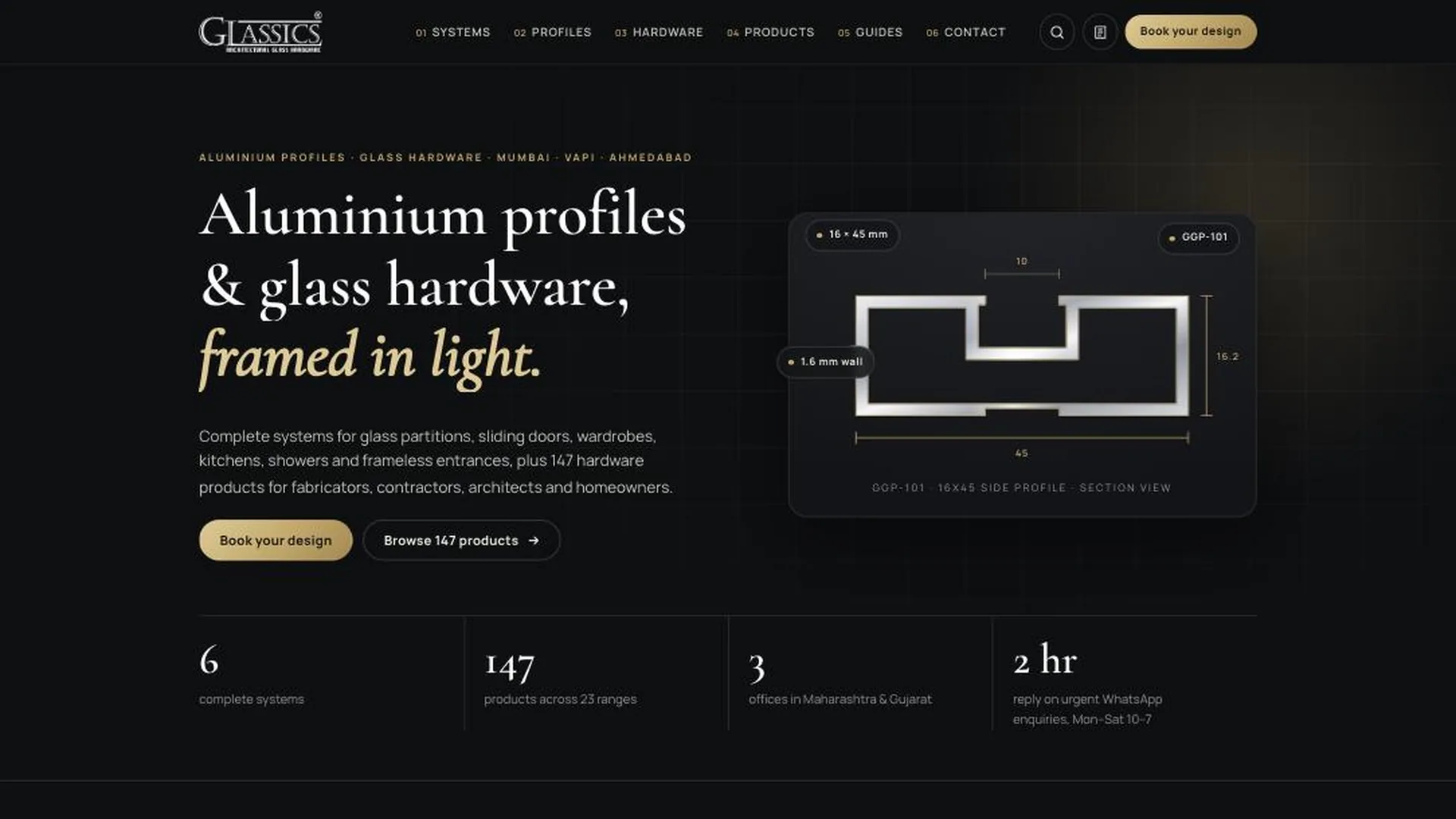
We threw out the JavaScript-only approach and rebuilt Glassics.in as a pre-rendered static site — 195 pages, every one of them complete HTML before a visitor or a crawler ever arrives. No assembly required. What you see in "view source" is the full page.
The structure breaks down like this:
- 147 product pages — one dedicated page per product. Every profile, patch fitting, hinge and floor spring gets its own URL, its own title, its own description.
- 23 range pages — category-level pages that group products the way buyers actually search.
- Systems, guides and a glossary — 6 complete system pages plus educational content that answers the questions buyers ask before they ever contact a supplier.
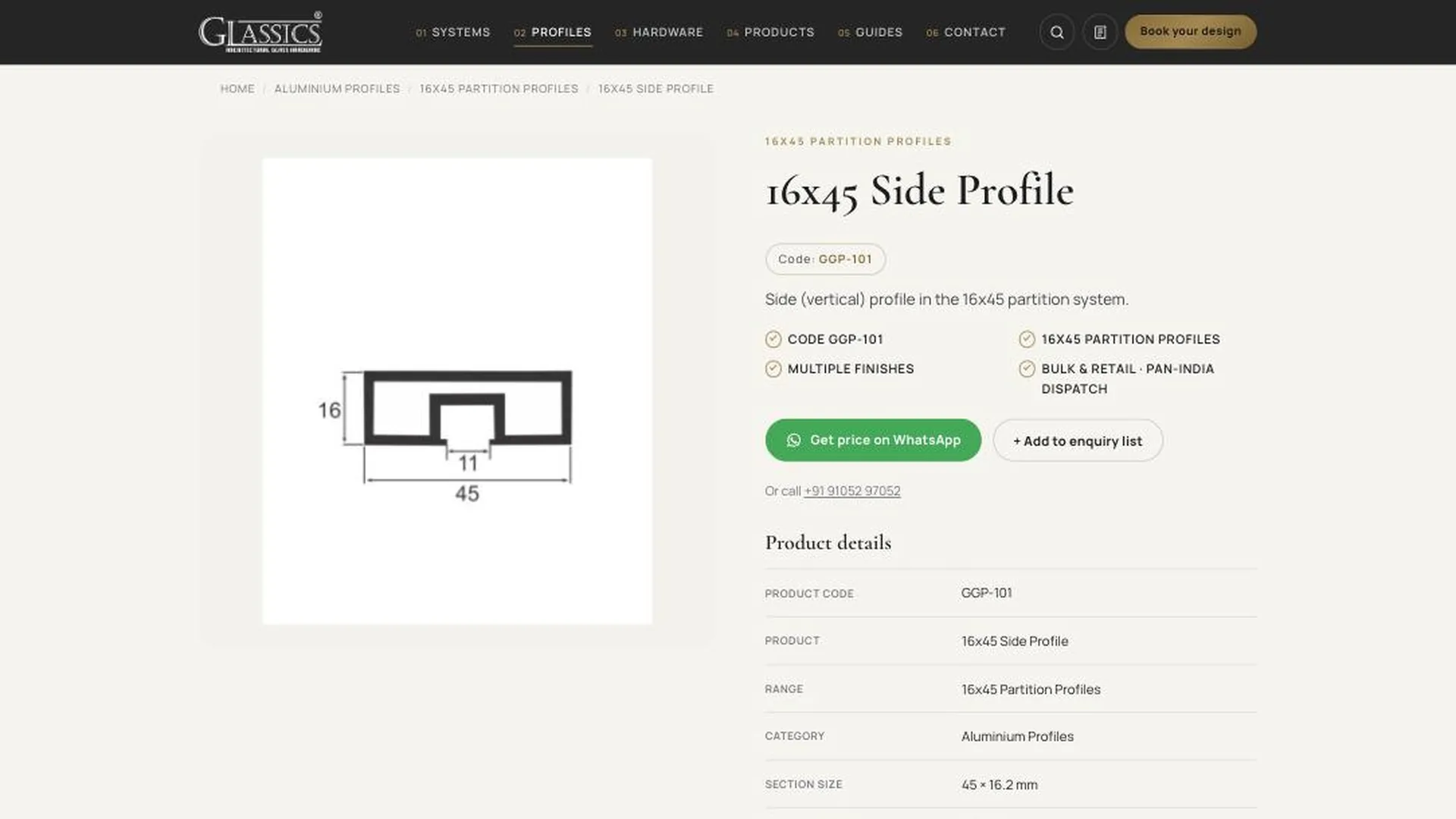
Why does the page count matter? Because in B2B search, specificity wins. A buyer searching for a telescopic sliding system doesn't land on a homepage — they land on the exact product page. 147 product pages means 147 chances to match an exact search instead of one generic homepage trying to rank for everything.
SEO, AEO and GEO — built in, not bolted on
Most websites treat SEO as something you add afterwards: a plugin here, a meta tag there. We built it into the foundation.
SEO (Search Engine Optimization): clean URLs, proper title tags and meta descriptions on every page, semantic HTML with one H1 per page, a sitemap, and internal linking between related products and ranges. The basics, done properly, on all 195 pages. It's the same approach behind our SEO services.
AEO (Answer Engine Optimization): buyers don't just type keywords any more — they ask questions. "What profile do I need for a 12mm glass partition?" The guides and glossary are structured to answer those questions directly, with FAQ sections and FAQ schema markup that search engines can lift straight into results.
GEO (Generative Engine Optimization): this is the new one, and it matters more every month. When someone asks ChatGPT or Perplexity "who makes slim aluminium partition profiles?", the AI needs readable, factual, well-structured content to cite. Pre-rendered HTML with clear headings, real specifications and no marketing fluff is exactly what these systems consume best.
Hosting and infrastructure
The site moved to Netlify hosting with the DNS pointed over directly. Static hosting means the pages load fast wherever the buyer is — Mumbai, Dubai or London. Product images are served through Cloudinary's CDN, so a buyer on a slow connection still gets the page in seconds.
The design: dark, premium, deliberate
A hardware brand competing for architects and distributors can't look like a 2010 catalogue site. The redesign takes its cues from premium automotive and industrial brands:
- Charcoal (#0e0f11) backgrounds with champagne gold (#c9a86c) accents
- Cormorant Garamond for headings — editorial, confident
- Manrope for body text — clean, highly readable
The idea is simple: when an architect or a distributor opens the site, it should feel like a brand that belongs in a premium project. First impressions close deals before the first email is sent.
What turned the catalogue into a buyer magnet?
Beyond the 147 product pages and 23 range pages, the rebuild added the content layer that turns a catalogue into a reference buyers return to. Six complete system pages walk buyers through full assemblies — sliding systems, partition systems, shower enclosures — showing how individual products work together, which is exactly how contractors and distributors think when they plan a project.
Four practical guides answer the questions buyers ask before they ever contact a supplier: how to measure for a sliding door, which hinge suits a heavy glass door, how to maintain patch fittings so they last. A glossary defines the industry terms buyers actually search for, capturing the long-tail queries that product pages alone never reach. And three city pages connect the factory to location-specific searches, so a buyer looking for a supplier in a particular region lands on a page built for them.
This is the unglamorous work that compounds. Every guide and glossary entry is another doorway into the site, another exact-match answer for a buyer with a specific problem. A manufacturer website isn't just a product list — it's a reference library that proves expertise before the first enquiry is ever sent.
What can manufacturers learn from this rebuild?
You don't need 195 pages to take the lesson. Here's the short version (more in our guide for manufacturers and exporters):
- If your site is JavaScript-only, you're invisible. View source on your homepage. If the product names aren't in the HTML, Google probably can't see them either.
- One page per product. A single "products" page with everything on it ranks for nothing. Give every product its own URL.
- Write for the question, not just the keyword. "Shower hinge 90°" is a keyword. "Which shower hinge do I need for a 10mm frameless glass door?" is a buyer. Answer the buyer.
- Structure for AI search now, not later. The buyers of 2027 will ask an AI before they ever open Google. Clean, factual, pre-rendered content is how you get cited.
What we're doing next
The rebuild is the foundation. On top of it comes the ongoing work: submitting the sitemap to Google Search Console and Bing Webmaster Tools, requesting indexing of the key product and range pages, connecting city pages to Google Business Profiles, and activating the contact form with proper notifications. A website isn't a project you finish — it's an asset you keep compounding. See more in the MeiXin Social blog.
Selling overseas but invisible on Google? We rebuild manufacturer websites the way we rebuilt Glassics.in — pre-rendered, SEO/AEO/GEO-ready, built to be found.
Get a free website audit on WhatsApp →